
ABHPC Prevention Pathways Monthly Bulletin for October 2024
Indigenous People’s Day
Monday October 14th marks this year’s Indigenous People’s Day. The holiday honors both the history of loss faced by Indigenous people and the resilience and survival of Indigenous people and their cultures. Indigenous People’s Day intentionally overlaps with Columbus Day, to reclaim visibility of the displacement, eradication, and generational trauma caused by the arrival of Christopher Columbus.
American Indian and Alaskan Natives (AI/AN) have higher rates of substance-related deaths and suicide deaths, which demonstrates the necessity of behavioral health prevention for AI/AN communities. It is important to acknowledge that research is limited and does not always accurately reflect the variety of experiences of different AI/AN tribes. There are resources and programs that can be adapted to fit the specific priorities and experiences of different AI/AN populations and that build on specific cultural protective factors.
Learn about those programs and other resources to learn about Indigenous populations through the resources below:
- Learn about the history of Indigenous populations in California at the Native American Heritage Commission.
- Read through and share these cultural awareness resources for Indigenous cultures, including this AI/AN Culture Card.
- Explore resources for youth behavioral health from Healthy Native Youth and We R Native.
- Find evidence-based prevention practices for Indigenous populations including the Gathering of Native Americans/Gathering of Alaska Natives.
- Learn about California health resources for tribal populations, including the California Rural Indian Health Board, Inc.’s Opioid Response Projects and the California Consortium for Urban Indian Health’s Medication Assisted Treatment Project.

Center for Substance Abuse Prevention – Six Prevention Strategies: Problem Identification and Referral
The Center for Substance Abuse Prevention (CSAP) has developed six major prevention strategies: information dissemination, prevention education, positive alternatives, environmental strategies, community-based processes, and problem identification and referral. These broad categories are used to describe the types of approaches effective in comprehensive substance use prevention.
Problem identification and referral is a strategy that identifies individuals who have experimented with age-inappropriate or illicit substances and assesses whether their behavior can be reversed through education. Methods for problem identification and referral include, but are not limited to, Employee Assistance Programs (EAPs), Student Assistance Programs, and Prevention Screening and Referral Services.
An EAP can do initial evaluations, provide short-term counseling, referrals, and follow-ups for employees whose substance use may be affecting their work performance. Schools often build Problem Identification and Referral into their student policies. For example, to reduce vaping, schools may require students who are caught vaping to meet with school officials and family and attend lessons on vaping hazards. From there, students may be required to attend additional after-school classes on vaping or be given referrals for treatment.
It is important to note that problem identification and referral does not include assessment for treatment services or treatment itself, rather activities and resources that are geared toward behavior change. If education efforts are ineffective in stopping further substance use, referrals must be made to agencies that can provide formal assessments and substance use treatment. Integrating multiple strategies, and incorporating cultural responsiveness, contribute to more successful prevention efforts.
The Social Ecological Model
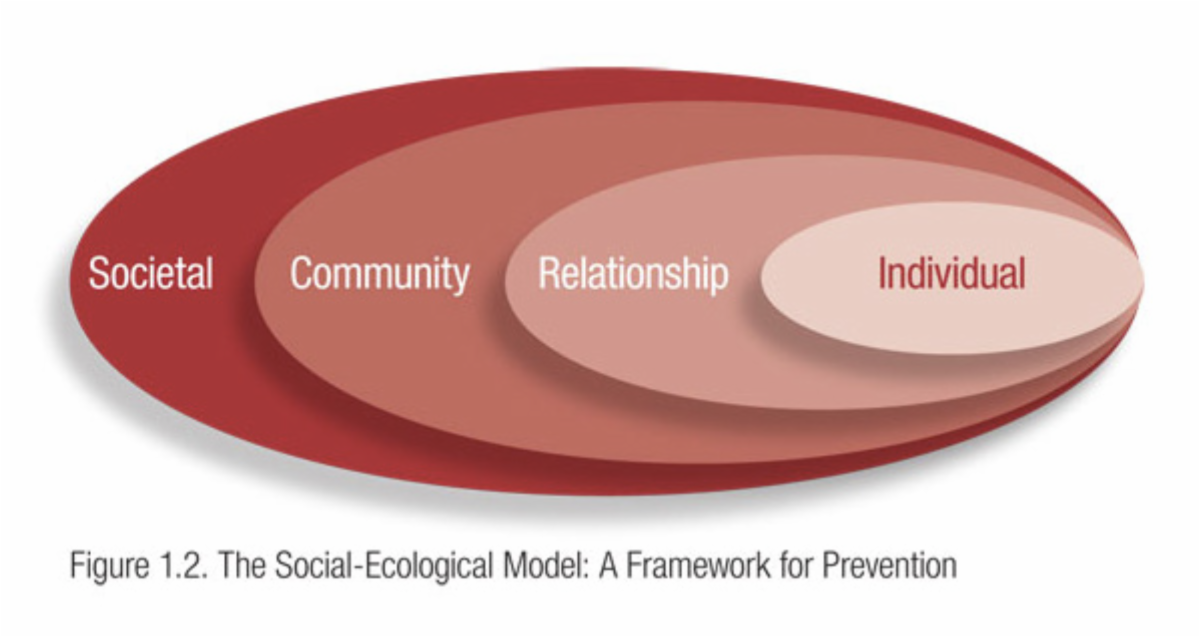
The social ecological model of health was developed by the Centers for Disease Control and identifies four categories, or levels, that can influence wellbeing – individual, interpersonal relationships, community, and societal. These levels represent ways people interact with, and are influenced by, their environment.
- Individual: includes both biological and circumstantial factors including age, education, mental/physical health, beliefs, trauma, and income.
- Relationship: including family, peers, significant others, and others we regularly interact with.
- Community: neighborhood and built environment, schools, workplace, organizations we belong to.
- Societal: culture, social norms, government and policies.
These levels come with unique risk and protective factors. As prevention professionals, we can integrate our programming efforts into each of these levels for successful implementation. The framework has applications beyond substance use prevention, including violence prevention, disease control, identifying adverse and positive childhood experiences, and others. Although culture is considered a factor in the societal level, we can incorporate the unique tenets of a focus population’s culture into each level of the framework.
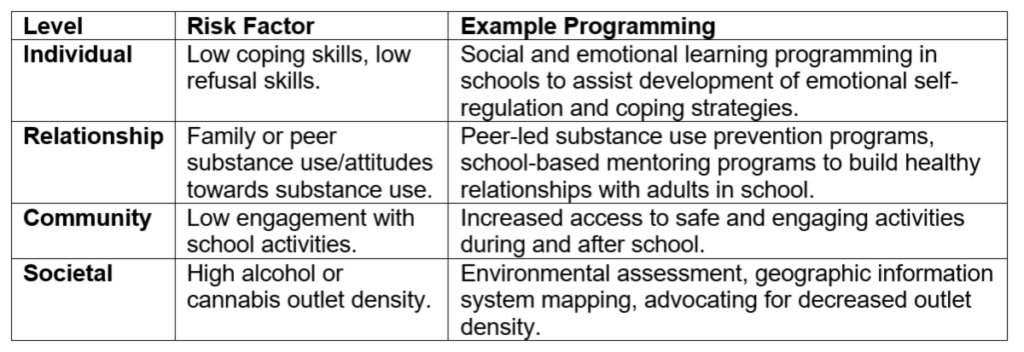
The following chart explores pairing risk factors with sample prevention strategies for youth and their environments in each level of the framework:
Community Spotlight: Center for Community Research
Joe Eberstein, CPS: Director of Community Engagement at the Center for Community Research, Inc.
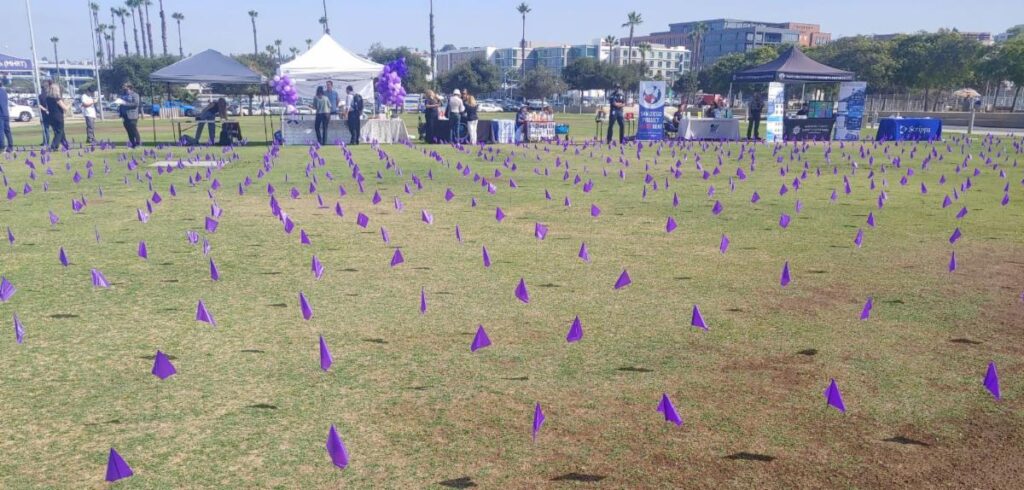
For this year’s 2024 San Diego Region International Overdose Awareness day, the Center for Community Research, Inc. placed flags on the county building lawn to remember those lost to overdose. Days of remembrance and visual demonstrations are an important way to spread awareness not only on the presence of opioids and overdoses, but the services and resources available for folks who are struggling with use.
The Center for Community Research, a San Diego-based nonprofit celebrating 15 years servicing the San Diego region, worked with the County of San Diego, and other substance use and overdose prevention groups to launch a new digital map to help individuals find resources, including medication assisted treatment facilities, Bridge programs, naloxone access and vending machines as well as prescription drug drop off locations! Check out the map.
If you are interested in having your organization or prevention program featured in an upcoming bulletin, email Olivia Shrago at oshrago@cars-rp.org to get started!