
ABHPC Prevention Pathways Monthly Bulletin for June 2025
Juneteenth
June 19th, or Juneteenth, is an annual celebration of the ending of slavery in the United States. The first Juneteenth was celebrated on June 19th, 1865, when Union troops came to Galveston Bay, Texas to inform enslaved peoples of their freedom, two years after President Abraham Lincoln’s Emancipation Proclamation. In 2021, President Joe Biden signed Juneteenth National Independence Day as a legal public holiday.
Despite the progress celebrated on Juneteenth, the history of slavery, the ensuing Jim Crow era, and the resulting structural and systemic racism continue to impact the health and wellbeing of Black Americans to this day. To address the imbalances caused by historic oppression, it is important to understand the concepts of structural and systemic racism and how these embedded injustices effect the daily lives of people of color, including the impact on behavioral health and substance use/misuse.
Systemic racism refers to “…forms of racism that are pervasively and deeply embedded in and throughout systems, laws, written or unwritten policies, entrenched practices, and established beliefs and attitudes that produce, condone, and perpetuate widespread unfair treatment of people of color” (Braveman, Arkin, Proctor, Kauh, and Holm, 2022). Examples include political disempowerment through gerrymandering, environmental injustices that influence physical health, the “school-to-prison pipeline”, and others. Systemic racism influences the social drivers of health, which in turn influence behavioral health. Prevention professionals can begin to address these inequities by incorporating culturally responsive practices and grounding prevention work in health equity values. Schouler-Ocak et. al (2021) developed a list of recommendations for health professionals to incorporate anti-racist values into their practices.
The links below have some ways you can celebrate Juneteenth across California – click each link for more detail:
- Long Beach Juneteenth Celebration
- Pleasant Hill’s Juneteenth Celebration
- Juneteenth Jazz Festival in Oceanside
Two-Spirit, Lesbian, Gay, Bisexual, Transgender, Queer/Questioning + (2SLGBTQ+) Pride Month
June is recognized annually as Pride Month for 2SLGBTQ+ communities. The month of June was selected as Pride Month to commemorate The Stonewall Uprising, a several-days-long protest against the harassment and discrimination faced by the 2SLGBTQ+ community. The Stonewall Uprising began on June 28, 1969, when police raided a gay bar in New York City. Although the gay rights movement had been underway in the United States for decades, The Stonewall Uprising sparked a new enthusiasm and push for 2SLGBTQ+ rights and saw the start of many 2SLGBTQ+ rights organizations including the Human Rights Campaign and others. Annual Pride Month celebrations include parades, community events, workshops, and more. You can check out Visit California’s website for a list of Pride Month events across the state.
2SLGBTQ+ communities face challenges such as discrimination and limited healthcare access and quality. These barriers, in turn, can impact behavioral health outcomes for 2SLGBTQ+ people. For example, Two Spirit people have increased substance misuse compared to heteronormative and cisgender peers. LGBTQ+ individuals face increased risk of trauma, substance use, being unhoused, and suicidal ideation as well. Although sex, gender, gender identity and expression, and sexual orientation are all protected classes in California, threats to 2SLGBTQ+ rights are pervasive throughout the country, with an increase in executive orders that impact the personal lives of transgender people.
Prevention professionals can help to address these barriers by providing supportive spaces for 2SLGBTQ+ communities. Using resilience-based strategies, interrupting microaggressions, creating inclusive spaces, and supporting civic engagement are all strategies that can promote healing for the community.
Strategic Prevention Framework: Cultural Responsiveness and Sustainability
The Strategic Prevention Framework (SPF) was created by the Substance Abuse and Mental Health Services Administration to provide prevention planners with a guide to comprehensively understand and address substance use and misuse in their communities. The steps of the SPF include assessment, capacity, planning, implementation, and evaluation. Cultural responsiveness and sustainability are woven throughout each step of the SPF.
» Cultural Responsiveness (referred to in the SPF as “cultural competence”) helps to ensure that prevention programs are developed, delivered, and evaluated so that members of focus populations benefit from them. Strategies to support cultural responsiveness include understanding the unique needs and strengths of a priority population, including the priority population in prevention planning and delivery, training prevention staff, and tailoring evidence-based practices to a priority population.
» Sustainability is the capacity to maintain outcomes over time. Prevention staff may come and go. Funding may come and go. New problems may arise. Old problems may resurface. The ability to maintain services over time, despite changes to staffing, funding, and the organizations we work in, creates sustainable programs and outcomes.
To ensure cultural responsiveness and sustainability, each step of the SPF – from collecting and analyzing data, to developing a capacity building plan, to formulating an evidence-based prevention plan, to implementing that plan and evaluating its results – all are done with your community, with its stakeholders, rights holders, and with those most personally impacted by substance use and misuse.
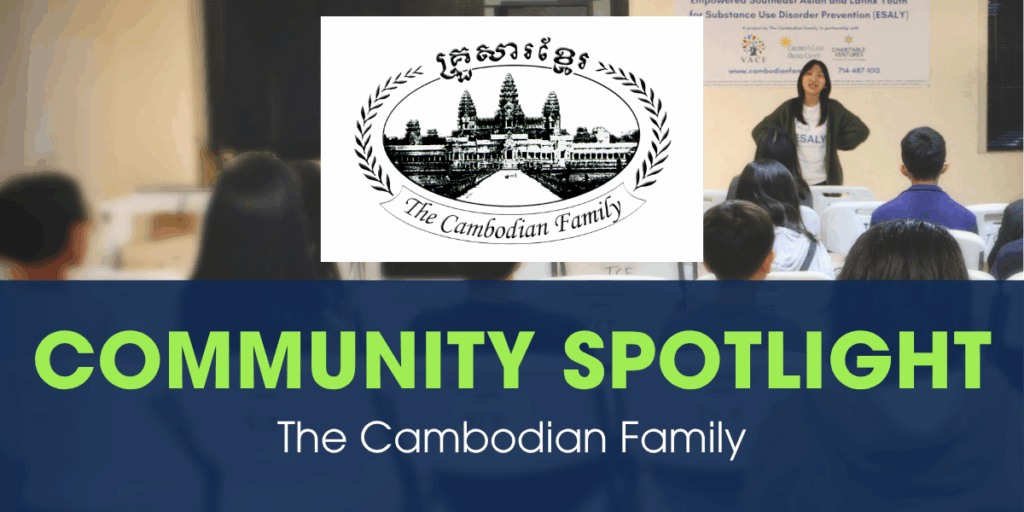
Community Spotlight: The Cambodian Family
Contributor: Vattana Peong – Executive Director
The Cambodian Family (TCF) developed the Empowering Southeast Asian and Latinx Youth for Substance Use Disorder (SUD) Prevention (ESALY) program to articulate and address a complex intersection of needs related to substance use within the multicultural and multigenerational community that they serve. ESALY delivers education and mentoring and supports youth-led advocacy to change the policy, systems, and environmental (PSE) landscape that challenges youth with regard to substance use. TCF engages these youth in a program that combines substance prevention and harm reduction education with civic engagement and organizing.
The work of recruiting, training, and empowering multi-ethnic youth, many of whose “home language” is either Khmer, Spanish, or Vietnamese, and whose cultures have unique and important impact on how these youth navigate their local communities and systems, is collaborative work. TCF works collaboratively within the community to ensure inclusive and responsive spaces for Southeast Asian and Latinx youth as they learn and share about the root causes of substance use, strategize, and advocate for upstream solutions to those causes.
Using the Project ALERT curriculum, youth counselors strive to create a fun, safe atmosphere for nearly 100 youth every year. Those interested are invited to stay on to learn more about systemic and root cause issues surrounding substance use and to gain skills to advocate for systems change related to the root causes.
Each year, the TCF team hosts youth listening sessions open to all SEA and Latinx youth in Santa Ana and beyond with the goal of co-creating the ESALY program as well as understanding the perspectives of youth. According to these youths, the primary reasons that youth use or abuse substances are to be cool, fit in, relax, de-stress, make problems go away, feel happier, and “have fun.” Members of the Youth Advisory Council engage more deeply with these root causes and potential solutions. The listening sessions are also an opportunity to garner new youth interest in the ESALY program.
It is hoped that from this combination of experiences, youth understand, in their eyes, the main issues leading to youth substance use and abuse in their community and what are the potential solutions. ESALY Program study findings indicate that, on average, the youth gain awareness and improve their attitudes toward substance use disorders by the end of the program. Youth themselves report feeling empowered to serve their community at the conclusion of their participation in our program.
“I learned a lot through this program with advocacy and learning the long-term consequences of substance abuse. I want to do more in my community, and support and help others when they need it!”
This program is funded by The Center at Sierra Health Foundation’s Elevate Youth California (EYC) initiative resourced by the California Department of Health Care Service.
The Cambodian Family
1626 E. 4th Street, Santa Ana, CA 92701
General Line: (714) 571-1966
Khmer & English: (714) 561-2589 Spanish & English: (714) 560-3169
ESALY/Project ALERT: (714) 487-1012
DHCS Announcements and Updates
Substance Use Disorder Integrated Care Conference – Registration is Open!
Registration is open for the 19th Annual Substance Use Disorder (SUD) Integrated Care Conference at the Hyatt Regency Long Beach from August 19-21, 2025! This highly anticipated three-day conference is designed for behavioral health professionals in SUD prevention, harm reduction, treatment, and recovery services. Register now to secure your spot! For questions about the SUD Conference, please email DHCSPrevention@dhcs.ca.gov
SAVE THE DATE: CBHA’s Spring Behavioral Health Policy Forum – June 18, 2025.
This in-person event will bring together behavioral health professionals, policymakers, and community-based organizations from across California to discuss fiscal sustainability, workforce challenges, innovation, and system change. Attendees will also receive critical updates on policy developments impacting behavioral health services, including PAGA, cybersecurity, LA wildfire resources, and CCBHCs. Advance registration is required. For more information, please visit the CBHA events page.
June 2025 CYBHI Quarterly Public Webinar – June 12, 2025, at 3:00p.m. PST.
Please join us for an update on the progress the Children and Youth Behavioral Health Initiative (CYBHI) and its workstreams are making to transform how California meets the behavioral health needs of our children, youth, and families. Advance registration is required.
If you are interested in having your organization or prevention program featured in an upcoming bulletin, email Olivia Shrago at oshrago@cars-rp.org to get started!