
ABHPC Prevention Pathways Monthly Bulletin for July 2025
National Minority Mental Health Awareness Month
July is National Minority Mental Health Awareness Month. Founded in 2008 in honor of mental health advocate Bebe Moore Campbell, this month aims to elevate conversations around stigma, access to care, and the cultural barriers that often prevent individuals from seeking and receiving the support they need. Many minority communities experience disparities in access to mental health services, language barriers, and discrimination within healthcare. This month highlights the importance of culturally responsive care and inclusive support systems. Through learning about the way different communities are affected by these barriers and elevating voices within these communities, we can make meaningful change.
Check out the following links for ideas on how to get involved in National Minority Mental Health Awareness Month:
- Long Beach Juneteenth CelebrationLearn about Bebe Moore Campbell’s life and impact on the mental health field.
- Check out Mental Health America’s “Turn Awareness Into Action” resources, including individual self-care worksheets, community building ideas, advocacy tips, and more.
- Explore the National Alliance on Mental Illness’s theme “Breaking Stigma: Hope, Healing, and Recovery – One Conversation at a Time” and their National Minority Mental Health Awareness Month Toolkit.

Disability Pride Month
July marks Disability Pride Month, a time to recognize and celebrate the history, achievements, experiences, and struggles of the disability community. Starting with the passage of the Americans with Disabilities Act (ADA) in July 1990, this month encourages us all to embrace disability as an essential part of human diversity. Disability Pride Month is not just about awareness – it’s about pride, identity, and empowerment. This is reflected in this year’s theme, “We Belong Here, and We’re Here to Stay.” This month is an opportunity to highlight the voices of individuals with disabilities and challenge the stigma that often surrounds disabilities.
Correlations between disabilities and mental or behavioral health are important to address as well. The emotional toll of having a disability can influence a person’s substance use/misuse. Certain mental health diagnoses and substance use disorders (SUDs) are considered disabilities under the ADA when they substantially limit one or more major life activities. Yet stigma remains a significant barrier to support. Mental health and SUDs often go unseen, and individuals may feel isolated or misunderstood. Disability Pride Month is an opportunity to recognize and uplift the voices of those living with mental health disabilities – emphasizing that emotional and psychological well-being is just as important as physical health.
Check out ideas for getting involved in Disability Pride Month this July:
- Find ideas on how to celebrate Disability Pride Month through The Arc.
- Listen to stories and learn more about Disability Pride’s “Disability is Not a Dirty Word” Campaign.
- Educate yourself about California-specific rights through Disability Rights California.
Prevention Models: Continuum of Care
In 1994, the Institute of Medicine (IOM) – now called the National Academy of Medicine – developed a continuum of care model that the behavioral health field adopted to describe prevention, treatment, and recovery services. The model is divided into three sections – prevention, treatment, and maintenance. The prevention arc is further divided into universal, selective and indicated prevention services.
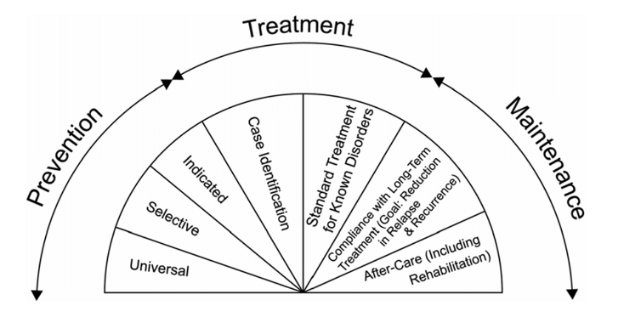
Universal prevention strategies address the general public or a segment of the entire population with average probability of developing a substance use disorder (SUD), risk, or condition with the goal to prevent the problem from ever occurring by providing information and skills to all individuals. Examples might include a school assembly attended by all students rather than for individual students’ potential risk factors, or a public awareness campaign like Alcohol Awareness.
Selective prevention strategies serve specific sub-populations whose risk of a disorder is significantly higher than average. A support group for youth who come from homes where drugs and alcohol are used daily is an example of a selective intervention. Such youth have a higher-than-average risk of substance use and misuse themselves, even if they haven’t started. A selective prevention strategy helps to reduce the risk that they will develop a SUD.
Indicated prevention strategies address individuals who have used substances and who have minimal but detectable signs or symptoms suggesting a disorder. Problem Identification and Referral, or an after-school group for youth found under the influence of a substance while on school grounds, are examples of an indicated prevention strategy. Indicated prevention aims to reverse early use of a substance thereby preventing a SUD from developing. If prevention strategies are insufficient to reverse a person’s use of substances, a referral to a licensed clinician is in order for assessment and diagnosis.
Prevention Models: Community Readiness Model
The Community Readiness Model (CRM) is a powerful tool designed to help communities assess how prepared they are to tackle specific health, social, or environmental issues. Developed by the Tri-Ethnic Center at Colorado State University, the CRM is grounded in the idea that sustainable change happens when a community’s level of readiness matches its strategies. The CRM mirrors the Stages of Change Model used to assess an individual’s readiness to change their behavior. The CRM offers a structured way to measure readiness across five key dimensions (knowledge of the issue, knowledge of current efforts, leadership, community climate, and resources) and then guides communities through action steps tailored to their current stage.
The model identifies nine distinct stages of readiness:
- No Awareness: The issue is not generally recognized by the community or leaders.
- Denial/Resistance: Some awareness exists, but there is little motivation to act.
- Vague Awareness: Most recognize the issue, but no immediate motivation or leadership exists.
- Preplanning: Community members are beginning to think about action and solutions.
- Preparation: Active leaders are planning, and resources are being allocated.
- Initiation: Programs or policies are underway and gaining support.
- Stabilization: Activities are supported by the community and operate consistently.
- Confirmation/Expansion: Efforts are evaluated, improved, and expanded as needed.
- High Level of Community Ownership: The issue is fully understood, and solutions are driven by widespread community involvement and sustained resources.
By identifying the current stage of readiness, prevention practitioners can tailor their strategies such as awareness campaigns, policy efforts, or coalition-building to meet the community where they are at and build sustainable, effective responses.
DHCS Announcements and Updates
Webinar: Medi-Cal Behavioral Health Student Loan Repayment Program (MBH-SLRP). July 9, 2025, 1:30 – 3:00 p.m.
The MBH-SLRP is offered by the Department of Health Care Access and Information (HCAI) as part of the Behavioral Health Community-Based Organized Networks Equitable Care and Treatment (BH-CONNECT) Workforce Initiative.
The goal for the MBH-SLRP program is to reduce educational debt for behavioral health professionals who commit to serving Medi-Cal members by offering up to $240,000 in educational loan repayment.
The application cycle opens July 1, 2025, and closes on August 15, 2025. Potential applicants, leaders, HR staff, administrators, program managers, and others who support or employ behavioral health professionals are invited to register here for the MBH-SLRP webinar to learn about the application process, eligibility requirements and service commitment, and behavioral health professions that qualify.
DHCS Launches New Substance Use Prevention Evidence-Based Resource Website to Support Youth Substance Use Disorder Prevention in California
On June 16, 2025, the Department of Health Care Services (DHCS), in contract with the University of California, Los Angeles Integrated Substance Use and Addiction Programs, launched the Substance Use Prevention Evidence-Based Resource (SUPER) website.
SUPER offers a searchable database of evidence-based practices (EBPs) and community-defined evidence practices (CDEPs), serving as a statewide resource that provides clear and accessible information to help California counties, service providers, tribal entities, and other organizations serving youth select culturally appropriate, relevant, and effective EBPs or CDEPs for preventing youth substance use disorders.
This information includes essential components of an EBPs or CDEPs, such as prevention strategies, risk and protective factors, local adaptations, costs, available training and technical support, and empirical evidence of impact.
If you have any questions about SUPER, please email DHCSPrevention@dhcs.ca.gov.
2025 California Child & Family Services Conference. Registration now open. September 2 – September 5, 2025, Anaheim.
The California Alliance of Child and Family Services is hosting this conference, which brings together professionals from child welfare, juvenile justice, mental health, and education for impactful sessions, interactive workshops, and networking opportunities designed to inspire action.
2025 Statewide Needs Assessment Plan Report.
Notifies the public and stakeholders of publication of the draft 2025 SNAP Report beginning June 24, 2025, for a 30-day public comment period. In compliance with the requirements of the Substance Use Disorder Prevention, Treatment and Recovery Services Block grant, the biennial 2025 SNAP Report describes the State’s assessment of incidence and prevalence of substance use disorder services. Please submit feedback to SUBG@dhcs.ca.gov using subject line “FFY 2025 SNAP Report” by 5:00 P.M., July 24, 2025.
Behavioral Health Services Act (BHSA) Population-Based Prevention Program Guide (Guide)-Phase 1.
The California Department of Public Health (CDPH) invites Californians to provide public comment on the first phase of BHSA population-based prevention program guidance via Microsoft Forms Survey by July 11, 2025, 11:59 p.m. CDPH also invites interested parties to participate in a public webinar on June 30, 2025, 9:00-11:00 a.m., to support and inform the planning, development, and implementation of the Guide-Phase 1. This open virtual meeting will consist of an overview presentation of the Guide-Phase 1 followed by dedicated time for participant feedback.
If you are interested in having your organization or prevention program featured in an upcoming bulletin, email Olivia Shrago at oshrago@cars-rp.org to get started!