
ABHPC Prevention Pathways Monthly Bulletin for January 2025
Engaging Refugee Communities in Prevention Efforts
California is one of the most re-located to states for refugees. Numbers of refugees have increased in recent years, with 25,500 refugees arriving in 2022 and 60,000 in 2023, following a dip between 2018 to 2022. Refugees are primarily from the Middle East (Iran and Iraq), Ukraine, and Laos and tend to settle in larger urban areas including Sacramento, San Diego, and Los Angeles.
The California Department of Social Services offers support to eligible participants through the Refugee Resettlement Program (RRP). The RRP provides financial and employment services, health services, services for refugee minors, and support for trafficked peoples. The California Department of Public Health’s Office of Refugee Health provides health services tailored to refugee populations and assistance with Medical. However, there are few substance use/misuse prevention services specific to refugee communities. Limited research has been done on refugee populations and substance use disorder. One theory suggests a “refugee paradox” based on research that shows that despite the life stressors faced by refugee populations, substance use disorders are lower than people born in the United States.
There are barriers and considerations present in engaging refugee populations in primary prevention. These include, but are not limited to, mistrust of institutions, risk factors such as financial, housing, and food insecurity, social isolation, and trauma. Prevention providers must take into consideration that each population is unique, and specific factors related to culture and experiences come into play when engaging refugee communities.
Methods to mitigate these barriers and increase engagement may include:
- Understanding the assumptions and biases we may have about the priority population.
- Assessments of the prevention needs of each refugee population as well as risk and protective factors.
- Collaboration with healthcare services and other existing programs for refugees to disseminate information about prevention services.
- Providing translators to support events and to assist with developing materials.
- Tailoring evidence-based programming to cultural considerations.
CSAP Six Prevention Strategies: Information Dissemination
The Center for Substance Abuse Prevention (CSAP) has developed six major prevention strategies: information dissemination, prevention education, positive alternatives, environmental strategies, community-based processes, and problem identification and referral. These broad categories are used to describe the types of approaches effective in comprehensive substance use prevention.
Information Dissemination strategies can include video and media, social media campaigns, written materials such as brochures or pamphlets, conferences and health fairs, and prevention curricula in schools, or speaking engagements. An important component for the success of Information Dissemination is to consider the focus audience and use that to tailor your outreach efforts. Conferences and health fairs might reach more adults and prevention or health professionals, while social and other media campaigns may be more successful in engaging younger audiences.
We can look at the Substance Abuse and Mental Health Services Administration’s “Talk. They Hear You” campaign as an example of the Information Dissemination strategy. This comprehensive campaign aims to educate parents and guardians on the prevalence of youth substance use and provide them with skills to discuss substance use with youths in their lives. The campaign created television, radio, and print public service announcements, media toolkits, webinars, podcasts, a phone app, and other content. The variety in content type helped the campaign reach a wide-spread audience.

Strategic Prevention Framework: Assessment
The Strategic Prevention Framework (SPF) was created by the Substance Abuse and Mental Health Services Administration to provide prevention planners with a guide to comprehensively understand and address substance misuse in their communities. The steps of the SPF include assessment, capacity, planning, implementation, and evaluation. Cultural responsiveness and sustainability are woven throughout each step of the SPF.
Assessment is the first stage of the framework. Assessment is how prevention planners use data to identify local needs and problems around substance misuse. Comprehensive data collection includes prevalence of substance misuse and related harms, risk and protective factors related to the problem, and an assessment of community capacity. Prevention planners begin by gathering and analyzing both existing state and local data and filling any identified gaps in data. Risk and protective factors relevant to the data can help prevention planners prioritize their efforts on what is most urgent to address, what is actually changeable, and can begin to identify what resources are available.
Community capacity assessments further identify the resources available in a community including people, connections, supplies, existing efforts, and others. Community readiness assessments should be done in face-to-face discussions with community members, stakeholders, and rightsholders. The assessments help identify the perceptions of the problem in the community and willingness to change, existing or previous efforts and resources to address the problems, and potential barriers to implementation.
Following these assessment steps, the prevention planner should share their findings to relevant stakeholders and community members. These findings should be tailored to the audience to garner important feedback and support. From there, prevention planners can begin to move into the next step of the SPF: capacity.
Community Spotlight: Orange County’s Strength in Numbers Club
The Strength In Numbers Club (@Strength_In_Numbers_OC) is a partnership between Providence Mission Hospital and the Alcohol and Drug Education and Prevention Team within Behavioral Health Services, Substance Use Disorders. This last school year, three student clubs in the Capistrano and Laguna Beach Unified School Districts worked to address the need for perfectionism that can lead students to unhealthy behaviors such as substance use. Their efforts are centered on empowering their peers to make healthier choices that support personal goals and wellbeing. This peer-to-peer model has been demonstrated to be effective when youth are involved in the program design, leadership, and implementation of the activities. With the devastating loss of young lives due to the opioid epidemic, club leaders hosted numerous prevention events to increase awareness about the dangers of prescription and other drug misuse. Three events are highlighted below.
Capistrano Valley High School:
Last fall, a fentanyl awareness presentation and panel discussion by Strength in Numbers club student leaders were hosted for 300 Capistrano Valley High School students. Topics included opioid overdose data, the dangers of fake pills as well as the threat of overdose related to opioid misuse. A message about only using medication prescribed to you by a physician, filled by a pharmacist and taken as prescribed was shared. Information about the Good Samaritan Law that provides protection for anyone reporting a suspected overdose was also discussed.
Laguna Beach High School:
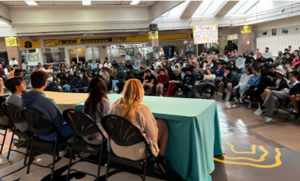
This past February, the Laguna Beach High School (LBHS) Strength in Numbers club educated 170 fellow students about fentanyl during their tutorial period. Club leaders gave a brief presentation on statewide opioid overdose data, the dangers of fake pills as well as the threat of overdose related to opioid misuse. Using Kahoot!, a game-based platform, students answered questions regarding the information that had been presented using their phones to enter responses that were then captured on a large screen. Club members did an amazing job keeping the student audience engaged.

Thurston Middle School:
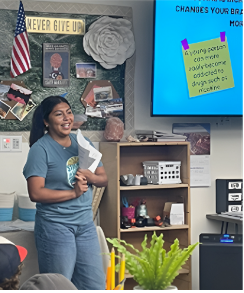
Just as the school year was winding down, LBHS club leaders facilitated a substance use prevention presentation for students at Thurston Middle School in Laguna Beach. The topics reviewed included substance use and its impact to the developing brain, chemicals in e-cigarettes and vapes, and media literacy skills to recognize when advertisers glamorize substances and target young people. Students were encouraged to be a positive influence and a role model for choosing a healthy lifestyle. The picture below shows off the prevention lesson led by a club member.
Looking Ahead:
Strength in Numbers Club students could have taken the summer off but they stayed engaged after the end of the school year. This summer, a group of club members met two times a week over a six-week period to develop prevention projects sharing a message of the dangers of substance use and the benefits of living a drug-free lifestyle. These projects have been presented to school staff and will be used in the three club sites. Looking to the new year, Club Rush will be their first opportunity to share their message of health and wellness and recruit new members. The clubs are ready and excited for another great year.
DHCS Announcements and Updates
DHCS Awards $65 Million to Community-Based and Tribal Organizations for Youth Substance Use Prevention
On December 19, DHCS awarded nearly $65.5 million in grant funding to 95 youth-serving community-based and Tribal organizations to expand substance use disorder prevention programs. Organizations will receive total awards for grants up to $1 million for the three-year grant period to implement the Elevate Youth California program in low-income, under-resourced communities and communities of color. These grants will support young Californians statewide in staying healthy by educating them about the risks of substance use disorders and how to prevent them.
If you are interested in having your organization or prevention program featured in an upcoming bulletin, email Olivia Shrago at oshrago@cars-rp.org to get started!