
ABHPC Prevention Pathways Monthly Bulletin for April 2026

Advanced Behavioral Health California Update
There are four (4) exciting events scheduled in April 2026 for Prevention Professionals. Stay tuned for announcements and registration!
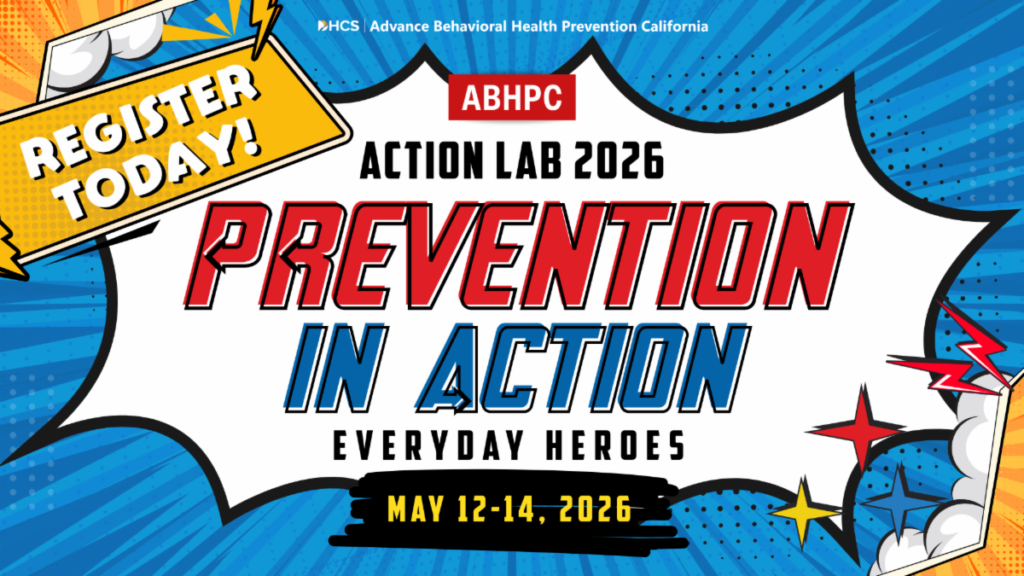
Registration is now open for the 2026 ABHPC Action Lab Prevention in Action: Everyday Heroes. This year’s Action Lab will be held May 12-14th, 2026 in Anaheim, CA. For more information and ongoing updates, check out our website.
Second Chance Month
April is Second Chance Month. This annual month of recognition brings awareness to the challenges faced by justice-impacted people and the resources available to support them. Approximately 1 in every 3 adults has a criminal record, and there are 44,000 estimated associated legal sanctions faced by those individuals. Those sanctions can limit access to housing, employment, higher education, and other important resources. Organizations and programs across California and the United States aim to address these barriers through advocacy, provide legal resources, education and training, case management, and more.
In 2022 the California Department of Justice began automatic record relief for “arrests that do not result in convictions, misdemeanor convictions that do not require registration under California’s sex offender registry law; and felony convictions for non-serious, non-violent, and non-registerable offenses.” Data collection about the impacts of record relief and efforts to increase awareness of the program are ongoing, but the reach of this relief program is already making meaningful changes for California residents.
To learn more about Second Chance Month and efforts to support justice-impacted people, check out California’s Anti-Recidivism Coalition, Prison Fellowship, and Los Angeles County’s Second Chance month proclamation.
National Public Health Week
National Public Health Week (NPHW) is April 6 – 12, 2026. This year’s theme is Ready. Set. Action! and invites people to reflect on progress in public health throughout the years and focus on change to come. NPHW is also intended to celebrate the efforts of public health workers. This year’s priority topics, developed by the American Public Health Association (APHA) include building partnerships with government agencies, scientific advancement, and community leadership.
In California, the California Department of Public Health (CDPH) has outlined a new Strategic Plan for 2025-2030 that includes five key priorities: Build a Healthy California for All, Reimagine Public Health, Communicate to Empower, Develop and Support Our People, and Address Emergencies and Other Emerging Issues. The plan intends to align with national public health priorities while prioritizing the unique needs of California residents. Substance use prevention efforts are a major component of public health – by promoting safe communities, healthy practices, and access to care, we can reduce substance use and misuse.
NPHW Resources:
- Explore upcoming virtual and in-person NPHW Events here.
- For toolkits and resources to get involved and promote NPHW check out the CDPH and APHA’s websites.
National Prescription Drug Take Back Day
April 25, 2026, is National Prescription Drug Take Back Day. Twice a year, communities across the United States host collection sites where the public can safely drop off unneeded, unwanted, and expired medications. Although many of these sites are accessible year-round for drop-off, Take Back Day helps promote these sites and increase awareness of safe storage and disposal practices. At the most recent National Prescription Drug Take Back Day in October 2025, 286 tons of material were collected across 4,317 collection sites.
Proper storage and disposal of medication is important for many reasons. Safe storage practices such as lockboxes, child-resistant caps, and keeping medications out of reach of children can help prevent accidental overdose and unwanted access. Proper disposal is also important for preventing substance misuse, accidental poisoning, and environmental damage as well.
For more information and to find collection sites near you, check out the Drug Enforcement Administration’s site locator.
Community Spotlight: Placer County: Rainbow Day Kids Connection
Contributors:
River Coyote (they/them) Health Education Program Coordinator II with Placer County Health and Human Services Substance Use Disorder Prevention
Placer County implemented a pilot program of Rainbow Day Kids Connection Curriculum-Based Support Group with 5th grade students who were bilingual (English and Spanish) and at high risk for substance use initiation. This new upstream program aims to prevent initiation of substance use by working on social emotional skills in a small group setting of 12 youth in need of extra support. The 12 sessions included getting to know their peers in the group, self-esteem, recognizing feelings, managing anger, hope, sense of purpose, dreams and goal setting, healthy friendships, healthy decision making, asking for help, refusal skills, coping with substance use/misuse in the home, and dealing with change. In the healthy decision-making class, we supplemented the curriculum to include more vaping and drug use education.
Each one-hour session begins with welcoming the youth and circle check-in about their week, a topic discussion of the day, and a fun experiential activity followed by reflecting on and processing what was learned Each class ends with positive affirmations. Because some youth in our English Learner group had low literacy and writing skills we tended to focus more on games, art, skits/role play, and discussion. Our group had a lot more energy and challenges with focusing so we at times used activities as the springboard for the topic discussion or had two activities in a session to keep it moving. We used prevention incentives from public health partners as participation prizes and rewards for winning a game. We were careful to vary different modalities each week for the lessons and activities to appeal to youth of different backgrounds.
There is a pre-assessment available for school staff and counselors to help refer students and to let us know what skills they need most. At completion, youth in grades 4th and up can take a confidential post opinion survey on alcohol/tobacco and drug use intentions and values. We were excited to see that:
- 100% of our youth participants stated that they “could say “no” to a friend who offered them drugs” and that it was “not ok for kids to smoke cigarettes or vape.”
- 90% said they “would not try drugs even if given a choice” and that they “could have fun without alcohol or drugs” and that “using drugs would get me into trouble” and “my life will be better without drugs.”
- 72% said they would not vape or smoke when they were older, and 9% don’t think they will. 9% said maybe they would, but no students said they planned to vape. Intentions to use alcohol when they are “old enough” were more varied with 9% saying they would not use, 36% saying they didn’t think they would use, 9% saying they might use and 36% saying they will use when they are old enough to.
We hope to continue providing this program in our elementary schools with youth who can use the extra time and attention in a fun and engaging curriculum-based support group designed to practice and develop protective factors against substance use. We hope to try it with 4th grade students next-stay tuned!
What’s the latest from DHCS
The Commission for Behavioral Health (CBH) has released the Innovation Partnership Fund (IPF) Request for Application (RFA)
Offering up to $20 million in grants to drive bold, equity-centered innovations in California’s public behavioral health system. This initiative, funded by the Behavioral Health Services Act (BHSA), supports solutions that improve mental health and substance use disorder services, with a focus on county behavioral health departments. Two grant categories are available: Small Grants (under $500,000) for community-based, non-profit, or tribal organizations, and Large Grants ($500,000-$5,000,000) open to all entity types. Key application requirements include innovation, addressing BHSA Priority Populations, supporting county programs, and focusing on cross-cutting elements like equity and lived experience. The application deadline is May 8, 2026. Learn more and apply at www.bhsoac.ca.gov.
Partnerships for Well Being Institute
DHCS and state System of Care partners are excited to invite you to the 2026 Partnerships for Well Being Institute (PWBI) from June 10-12, 2026, in Garden Grove, CA. California’s premier learning event for System of Care professionals, the PWBI is dedicated to advancing the health, safety and well-being of children and families. Presented in partnership with the California Department of Social Services, Department of Developmental Services, Department of Education, the Office of Youth and Community Restoration, and UC Davis Human Services, this event reflects a shared commitment to integrated care and cross-sector collaboration. For more information, please visit here.
Abstract submissions are now open for the 2026 National Prevention Network (NPN) Conference
We are excited to announce that abstract submissions are now open for the 2026 National Prevention Network (NPN) Conference, taking place virtually on September 29–30, 2026. The NPN Conference brings together prevention professionals from across the country to share the latest research, innovative strategies, and best practices in substance use prevention.
Call for Abstracts
We invite you to submit proposals that highlight:
- Evidence-based and Evidence-informed Programs, Strategies, and Policies to Prevent or Reduce Substance Use
- Overcoming Challenges and Opportunities for Resilience in Substance Use Prevention Work
- Substance Use Prevention Programs, Strategies, and Policies for All
- Intersection of Substance Use Prevention and Other Health/Social Issues
- Substance Use Prevention Workforce Development
- Technology’s Influence on Substance Use Prevention
Proposals should address the conference theme: Mastering the Craft of Prevention: Where Science and Practice Meet.
Important Information:
- All abstracts must be submitted through the online submission website: Call for Abstracts 2026 | NPN Conference
- Abstracts will be accepted until Monday, April 27, 2026
More information is available on the NPN Conference website: We hope you will join us for this engaging and impactful event! Registration opens: Tuesday, April 7, 2026.
If you are interested in having your organization or prevention program featured in an upcoming bulletin, email Olivia Shrago at oshrago@cars-rp.org to get started!